How to build a dating app: features, safety, matching and MVP scope
Building a dating app is less about copying swipe mechanics and more about trust, density and a clear audience. Here is a practical guide to features, matching, safety, privacy, monetisation and what to ship first.
If you are working out how to build a dating app, the code is rarely the hardest part. Profiles, matching and chat are well-understood problems. The hard parts are human: giving people a reason to choose your app over the ones already on their phone, making them feel safe enough to share photos and meet strangers, and getting enough of the right people into one place at the same time that every new member finds someone worth talking to.
This guide walks through the decisions that matter, in roughly the order they come up: what to build first, what to leave for later, and where dating products tend to go wrong.
Start with an audience, not a feature list
The general-purpose dating market is crowded and well funded. New products usually win by serving a narrower group better: a shared faith or culture, a life stage, a profession, a lifestyle, a city, or a specific intent such as marriage, friendship or something casual.
A clear audience simplifies almost every later decision:
- Onboarding asks the questions that matter to this group, and skips the rest.
- Matching can use signals that a general app cannot, such as values, family involvement or relationship goals.
- Marketing becomes possible on a small budget, because you know where these people already gather.
- Tone and design can feel like they were made for the people using them.
Matrimonial products are a good illustration. SME Matrimony, a Muslim matrimonial platform we have worked on, serves individuals and families, and that one fact shapes everything from who can view a profile to how introductions happen. A swipe interface would be the wrong starting point.
Before writing code, write one paragraph describing your first thousand users: who they are, what frustrates them about existing apps, and where you will find them.
Core dating app features
Every dating app needs four building blocks. Get these right before adding anything clever.
Profiles
Photos, a short bio, the basics your audience cares about, and prompts that reveal personality. Ask for too little and matches feel random; ask for too much and people abandon sign-up. Progressive profiles, completed after the first matches, help.
Discovery
How people browse potential matches: a card stack, a curated daily selection, a grid, or a search with filters. The format signals intent. Rapid swiping suits casual dating; a handful of thoughtful daily picks suits people looking for something serious.
Matching
The logic that decides who sees whom, and when two people can talk — usually after a mutual like, though some apps let one side message first or allow messages with an introduction.
Messaging
Real-time chat with delivery and read status, photo sharing, and easy access to report, block and unmatch from inside the conversation. Many apps later add voice notes and video calls.
Trust and safety: the feature users judge you on
People share personal photos and arrange to meet strangers through dating apps. If they don't feel safe, nothing else matters. Plan safety during discovery, not after the first incident.
- Verification. Phone or email at sign-up, then optional selfie or photo verification with a visible badge. Yaadle, a dating app in our portfolio, is built around verified profiles for exactly this reason: trust established early makes conversations easier.
- Reporting and blocking. One tap from any profile or chat, with clear categories and a confirmation that the report was received.
- Moderation. Automated screening of photos and messages for nudity, harassment, scams and spam, backed by a human review queue with each user's history, so your team can act consistently.
- Safety tools. Unmatch that removes the conversation for both sides, private or incognito modes, controls over who can message first, and guidance for meeting in person.
- Abuse signals. Mass messaging, rapid account creation or off-platform payment requests should trigger review automatically.
Matching approaches, from simple to smart
Founders often want an AI matching engine on day one. In practice, matching should grow with your data.
- Rules and filters. Distance, age range, intent and dealbreakers. Simple, transparent and enough to launch.
- Compatibility questionnaires. Weighted answers to questions your audience cares about. Useful for serious-intent and niche apps, and easy to explain to users.
- Behavioural ranking. Ordering candidates by signals such as recent activity, reply likelihood and mutual interest, so active, responsive people are shown more.
- Machine-learning recommendations. Models that learn from likes, matches and conversations. They need meaningful volumes of data to beat good rules, and they can amplify existing biases — for example by repeatedly favouring a narrow set of profiles — so they need monitoring.
- AI conversation starters. Suggested openers based on shared interests or profile prompts. Helpful for nervous first messages, but they should stay suggestions the user edits, never messages sent on someone's behalf.
Whatever you choose, keep users in control: let them see why someone was suggested where possible, and never let a ranking system quietly hide people without a reason. Our guide to designing AI features people trust covers this balance in more depth, and our AI app development team builds recommendation and moderation models when the data justifies them.
Privacy and data protection
Dating apps hold some of the most sensitive data a person can share: location, photos, sexual orientation, religion, relationship history and private messages. Treat it accordingly. This is general guidance, not legal advice — take advice for the markets you launch in.
- Location precision. Show approximate distance, never exact coordinates, and round or fuzz location on the server so it cannot be triangulated through repeated queries.
- Photo privacy. Strip metadata such as GPS tags from uploads, serve images through access-controlled URLs, and consider blurred or private photos that unlock only for matches.
- Data minimisation. Collect only what matching and safety genuinely need, and explain why you ask for anything sensitive.
- User rights. Under GDPR-style regimes, people can expect to access, export, correct and delete their data. Build account deletion that actually deletes, and a data export, from the start.
- Security basics. Encryption in transit and at rest, strict access controls for staff tools, and audit logs on who viewed what.
Dating app monetisation models
How you charge shapes how the community behaves, so decide early.
- Freemium. Core matching and messaging free, with paid extras. Keeps the community large, which benefits paying users too.
- Subscriptions. Tiers that unlock features such as unlimited likes, advanced filters, seeing who liked you or travel modes.
- Consumables. One-off purchases such as boosts for visibility or super-likes to stand out.
- Events and services. Paid events, introductions or premium matchmaking, common in matrimonial and niche products.
Be careful not to paywall basic safety or make free users feel invisible; a product that only works for paying members tends to empty out.
Solving the cold-start problem
A dating app with too few people nearby is a bad dating app, however good the code. This "liquidity" problem is the biggest reason new apps fail.
- Launch narrow. One city, campus or community at a time, so density builds where people actually are.
- Use a waitlist or invite-only launch and open the doors when there are enough members to make the first session rewarding.
- Seed through communities your audience already trusts: events, associations, creators and partners.
- Design for low density. Wider default distance, slower daily picks rather than an endless stack, and honest messaging when there are few new profiles.
Choosing a tech stack for dating app development
Most dating apps today use one cross-platform codebase for iOS and Android. Flutter app development suits a strongly branded, animated interface; React Native development suits teams with React experience. Our mobile stack comparison covers the trade-offs.
Behind the apps you typically need:
- A backend API (commonly Node.js or Python) for profiles, preferences, matching and payments.
- Real-time messaging over WebSockets or a managed real-time service, with offline sync and push notifications.
- A relational database such as PostgreSQL, with geospatial queries for distance-based discovery.
- Media storage and a CDN for photos and video, with automated image moderation.
- An admin console for moderation queues, user history and enforcement.
- Cloud hosting on AWS, Google Cloud or similar, with monitoring from day one.
- In-app purchases through Apple and Google billing for digital features.
App store guidelines to plan for
Apple and Google both review dating apps closely. Plan for these from the start rather than discovering them at submission:
- In-app reporting and blocking, and a way to filter objectionable content, are expected for apps with user-generated content.
- Users must be able to delete their account from inside the app.
- Digital features such as subscriptions and boosts generally must use the stores' own billing.
- Age restrictions and content ratings must be accurate, with age gating enforced in the product.
- Privacy labels and permission prompts must match what the app actually collects.
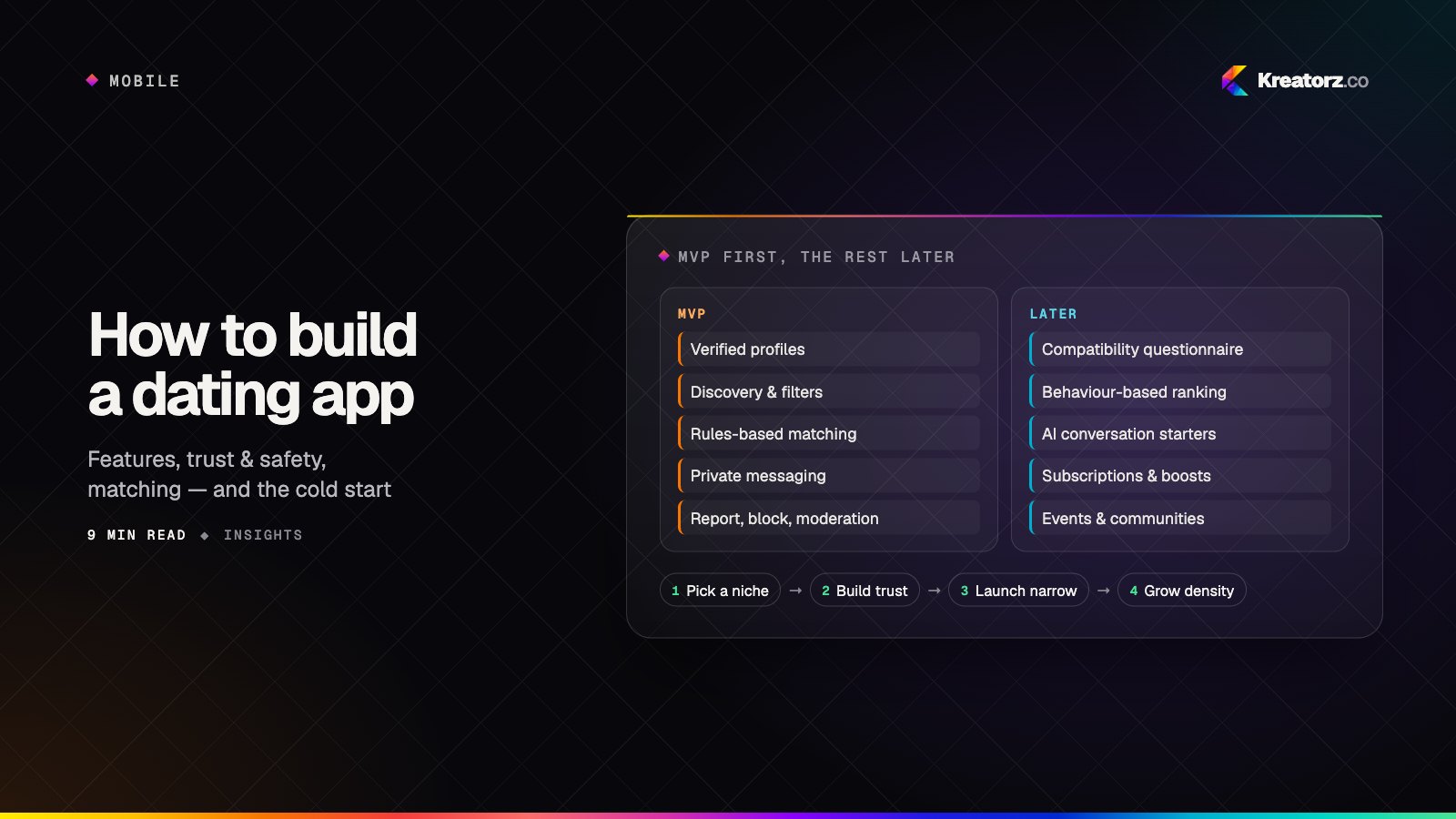
MVP scope: what to build first
A dating MVP should prove that your audience signs up, matches and has good conversations. Everything else can wait. Our MVP development approach — and the process in idea to MVP in weeks — is about testing that core loop quickly.
| Area | MVP | Later |
|---|---|---|
| Profiles | Photos, bio, basics, a few prompts | Voice and video intros, richer prompts |
| Discovery | One format with core filters | Multiple modes, travel mode, advanced filters |
| Matching | Rules and filters, simple ranking | Compatibility scoring, ML recommendations |
| Messaging | Real-time chat, photos, read status | Voice notes, video calls, AI conversation starters |
| Safety | Verification, report, block, unmatch, moderation queue | Selfie verification at scale, date check-ins, safety centre |
| Monetisation | One subscription tier | Boosts, consumables, events, multiple tiers |
| Admin | Moderation queue and user lookup | Analytics dashboards, automated enforcement |
Safety is substantial even in the MVP column — deliberately.
Building it well
A dating app succeeds when the right people feel safe enough to show up and find someone worth talking to. Pick a clear audience, launch where you can build density, put trust and privacy into the foundations, and let matching become smarter as your community grows. If you would like a second opinion on your concept or scope, see how we approach dating app development, or get in touch — we are happy to talk it through.
Frequently asked questions
How long does it take to build a dating app?
It depends on scope. A focused MVP with profiles, discovery, matching, chat and core safety is far quicker than a full product with video and advanced matching. A short discovery phase produces a realistic timeline.
Do I need AI matching to launch?
Usually not. Rules, filters and a simple compatibility questionnaire are enough to launch and are easier to explain. AI recommendations become useful once you have enough real activity to learn from.
Should I build for iOS and Android at the same time?
Most new dating apps do, because your audience will use both. A cross-platform framework such as Flutter or React Native lets one team ship to both stores from a single codebase.
How do I stop fake profiles?
Layer your defences: sign-up verification, optional selfie verification, automated screening of photos and messages, behavioural signals for suspicious activity, easy reporting and a human review queue.
What is the best way to get the first users?
Launch in one city or community at a time, often invite-only, and seed through groups your audience already trusts. Density matters more than total downloads.
Can a dating app be free?
Yes. Many use a freemium model where matching and messaging are free and optional extras are paid. Keeping the free experience good protects the size and health of the community.
Related services
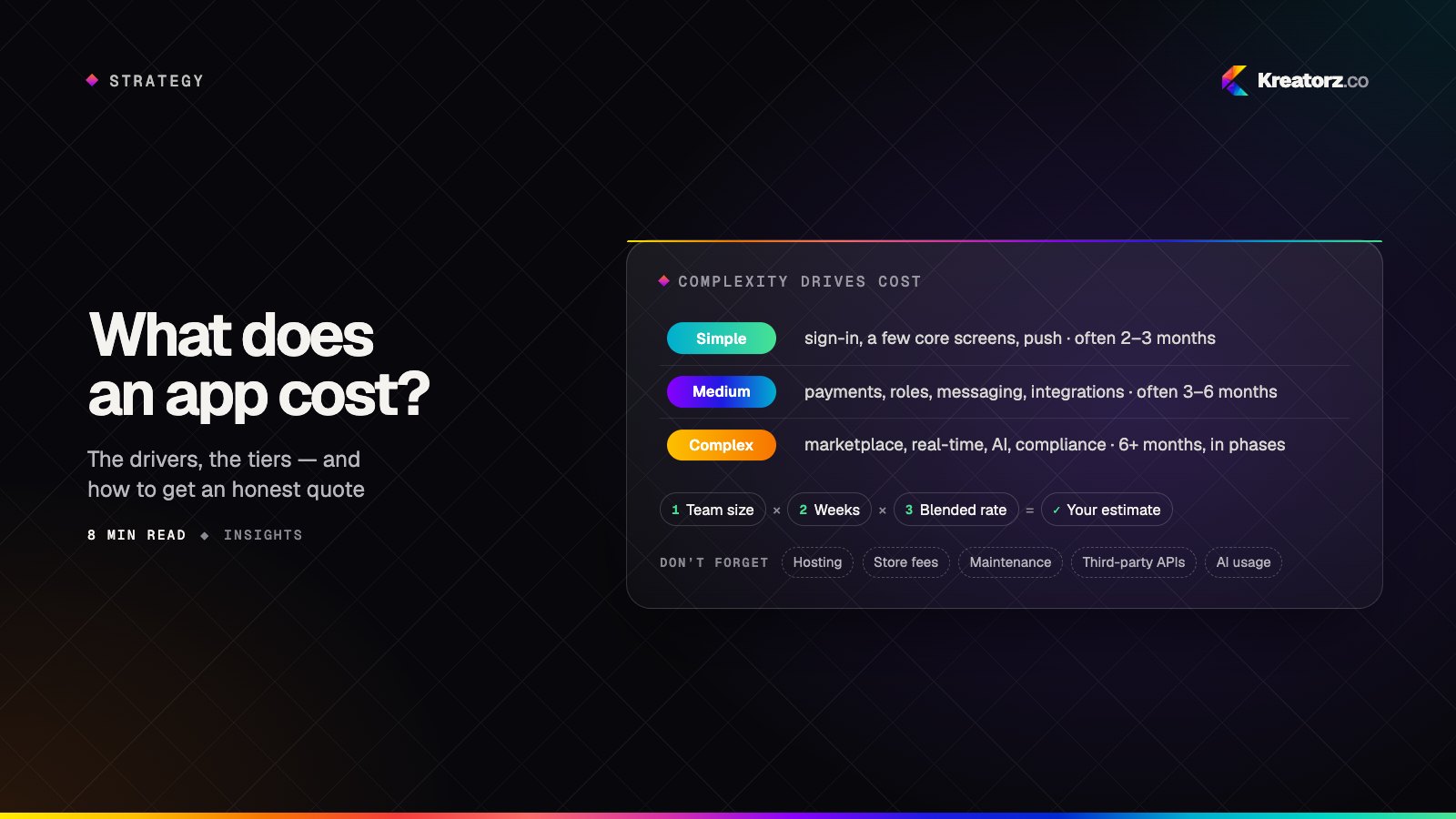
How much does it cost to build an app? A practical guide for 2026
There is no single price for an app, but there is a reliable way to reason about it. Here is what actually drives app development cost, how complexity tiers compare, how to estimate a budget yourself and how to reduce cost without cutting quality.
15 November 2026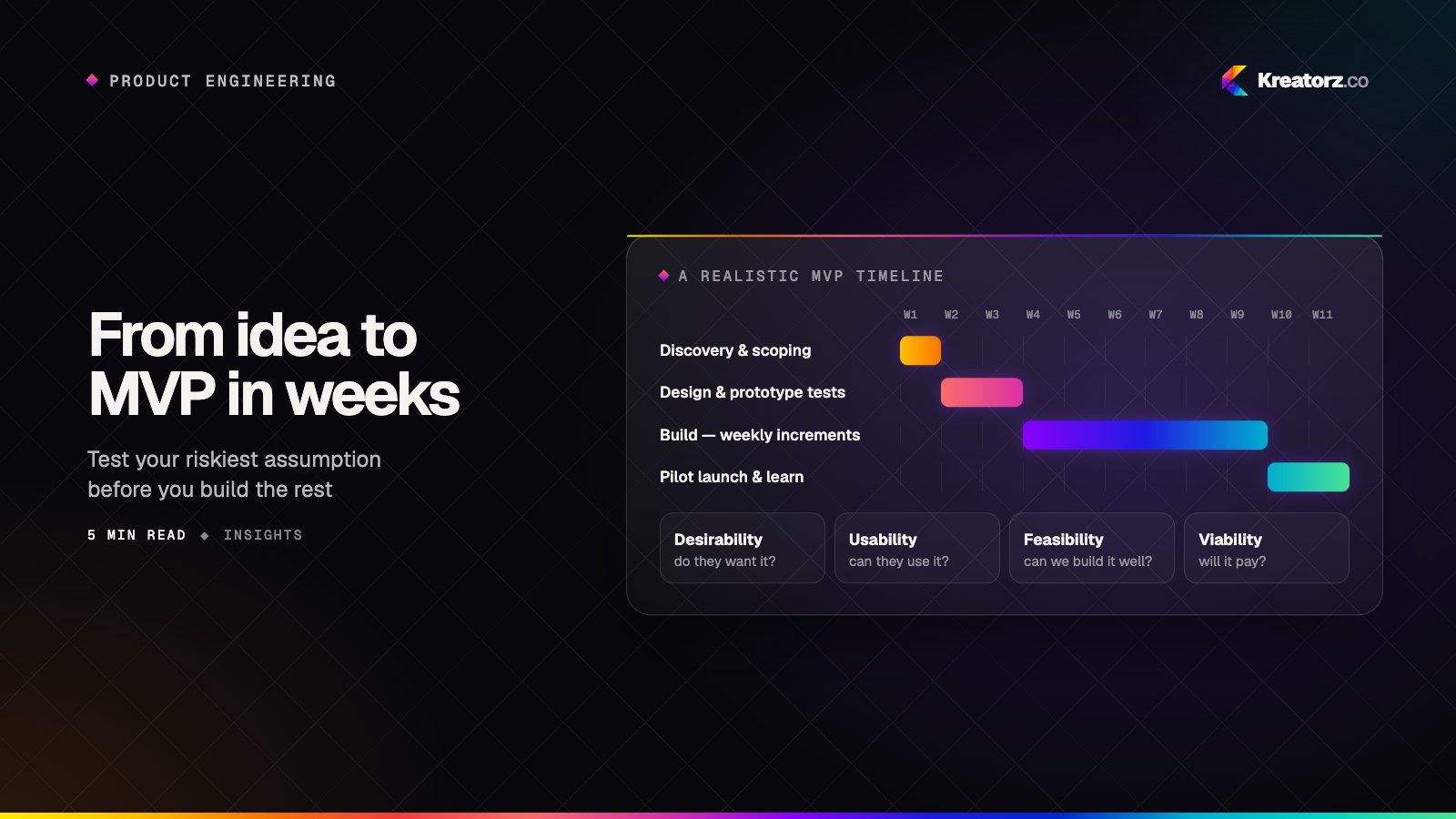
From idea to MVP in weeks: how to de-risk a new product
A minimum viable product is not a smaller version of the final product — it is the fastest honest test of your riskiest assumption. Here is the process we use to launch quickly without building the wrong thing.
14 October 2026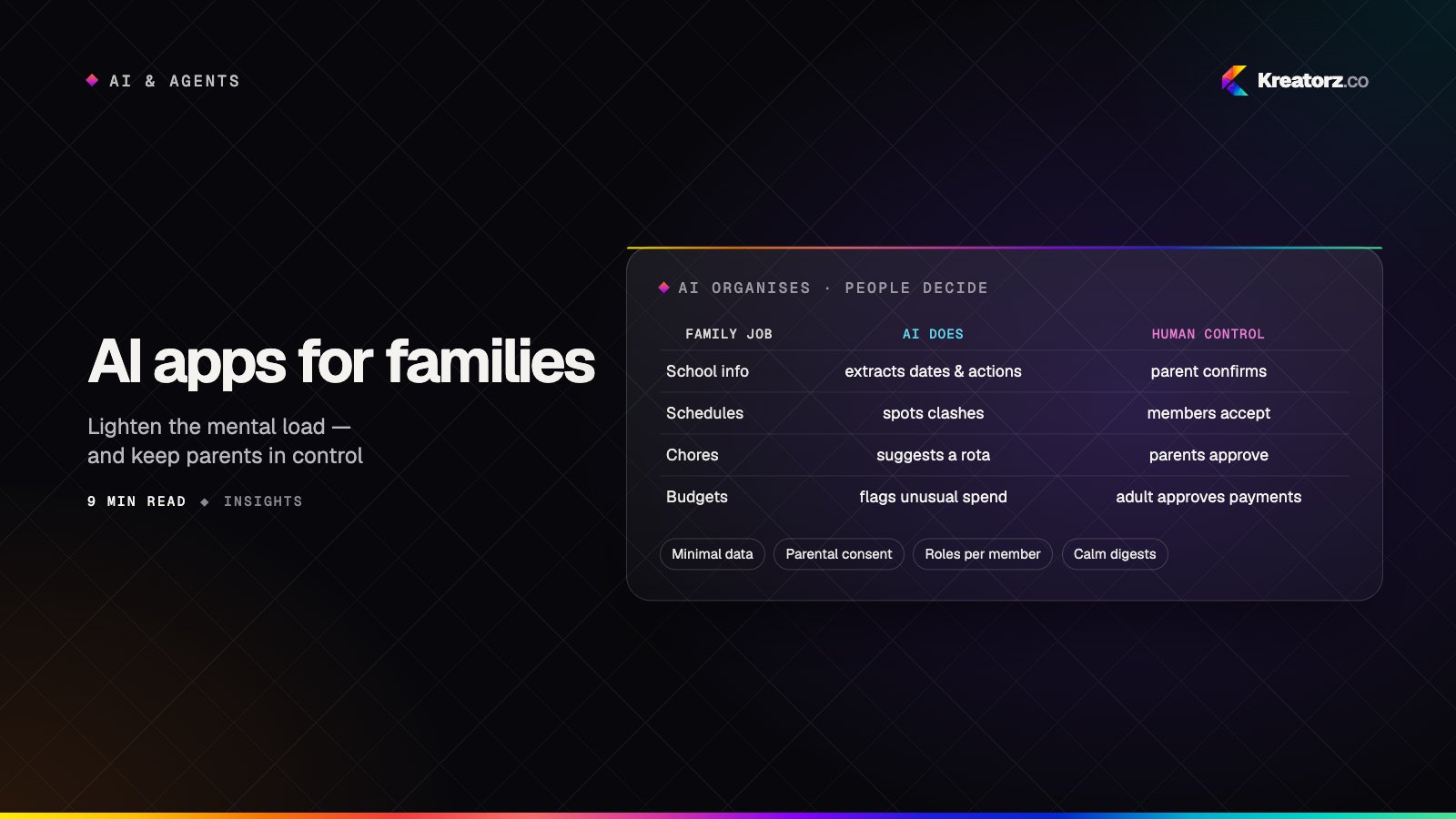
AI apps for families: how to build a family app parents actually trust
Families are drowning in schedules, school emails and small decisions. AI can genuinely lighten that load — if it is designed around real household jobs, several family roles, children's privacy and clear human control. A guide for product teams.
15 November 2026