If your company already runs on React, your mobile app probably should too. React Native lets the same people, patterns and much of the same code power your web product and your iOS and Android apps. Kreatorz is a React Native app development company that builds those apps in TypeScript, using native components under the hood so they look and behave like proper platform apps.
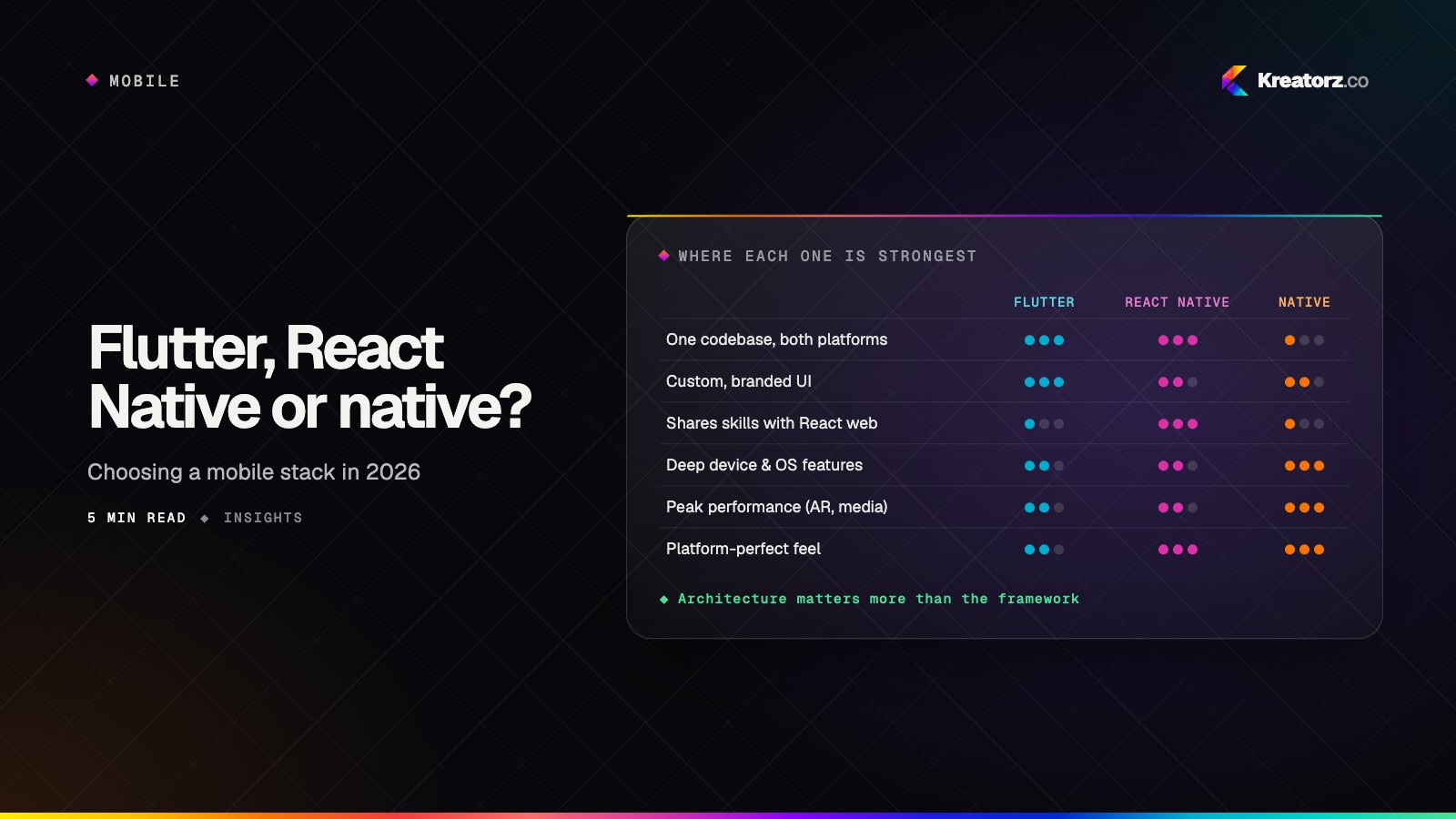
We are not tied to a single framework. If your product needs a heavily custom interface and you have no React investment, Flutter may suit you better; if you depend on deep platform features, native iOS or native Android may be the answer. When React Native is the right fit, it is a very efficient way to build.
Why companies choose React Native development services
- Shared skills. Your React web developers can read, review and contribute to the mobile codebase.
- Shared code. Validation rules, API clients, state logic, types and design tokens can live in one place for web and mobile.
- Native components. React Native renders real platform views, so lists, text inputs and navigation feel native by default.
- Fast iteration. Fast Refresh shows changes instantly during development, and over-the-air updates deliver JavaScript fixes without waiting for store review.
- A mature ecosystem. Expo, React Navigation, Reanimated and a broad library ecosystem cover most of what modern apps need.
Sharing code between React web and mobile
The biggest advantage of React Native comes when it sits alongside a React or Next.js web app. We typically structure these products as a monorepo:
- Shared packages for TypeScript types, API clients, validation schemas, business rules and analytics events
- Separate UI layers where web and mobile genuinely differ, so neither platform compromises the other
- One backend contract, often REST or GraphQL from a Node.js service, consumed identically by every client
- Common tooling for linting, testing and CI, so quality standards are the same everywhere
The result is less duplicated work and fewer inconsistencies — a pricing rule changed once is correct on the website, iPhone and Android at the same time. Our React development and full-stack development teams work on the same codebase, so web and mobile stay aligned.
Modern React Native: TypeScript, Expo and the new architecture
TypeScript throughout
Every project is written in strict TypeScript. Types shared with the backend catch integration mistakes before they reach users and make large codebases easier to change safely.
Expo and EAS
For most new apps we use Expo with development builds. It handles native configuration, provides well-maintained modules for camera, notifications and media, and EAS takes care of cloud builds and store submission. When a product needs custom native code, we write Swift or Kotlin modules and keep using Expo's tooling.
The new architecture
React Native's new architecture — Fabric for rendering, TurboModules and JSI for native communication — removes much of the old bridge overhead. We build new apps on it and help existing apps upgrade, auditing third-party libraries for compatibility first.
Over-the-air updates
OTA updates let us push JavaScript and asset fixes directly to installed apps. We use them responsibly: within store guidelines, with staged roll-outs, and with a native build whenever a change touches native code or meaningfully alters functionality.
React Native vs Flutter
| React Native | Flutter | |
|---|---|---|
| Language | TypeScript / JavaScript | Dart |
| UI | Native platform components | Flutter's own rendering engine |
| Web code sharing | Strong with React and Next.js | Separate web build from the same Dart code |
| Team fit | React and web developers | Teams happy to adopt Dart |
| Updates | OTA for JavaScript changes | Store releases |
| Best for | Products with a React web app or React team | Custom, highly branded interfaces |
Both are excellent choices for cross-platform app development. Our guide to choosing a mobile stack explores the decision in more depth.
What we build with React Native
- Companion apps for SaaS products, sharing logic and authentication with the web platform — see SaaS development.
- Productivity and relationship apps with shared task management, partner collaboration, shared calendars and personalised growth tracking, like the couples app Revelita.
- Payments and tipping apps with QR code tipping, secure digital payments, real-time tip tracking and team tip management, like Easy Tipping.
- Social and dating apps with profiles, matching, chat and real-time notifications — see dating app development.
- Marketplaces and e-commerce apps with catalogues, payments and order tracking.
- Content and community apps with feeds, media and push notifications.
- Internal tools that extend existing React dashboards onto phones and tablets.
How we deliver React Native apps
- Discovery — goals, users, existing web code and the opportunities for sharing.
- Architecture — monorepo layout, state management, navigation, native modules and backend contract.
- Design — a cross-platform design system that respects iOS and Android conventions.
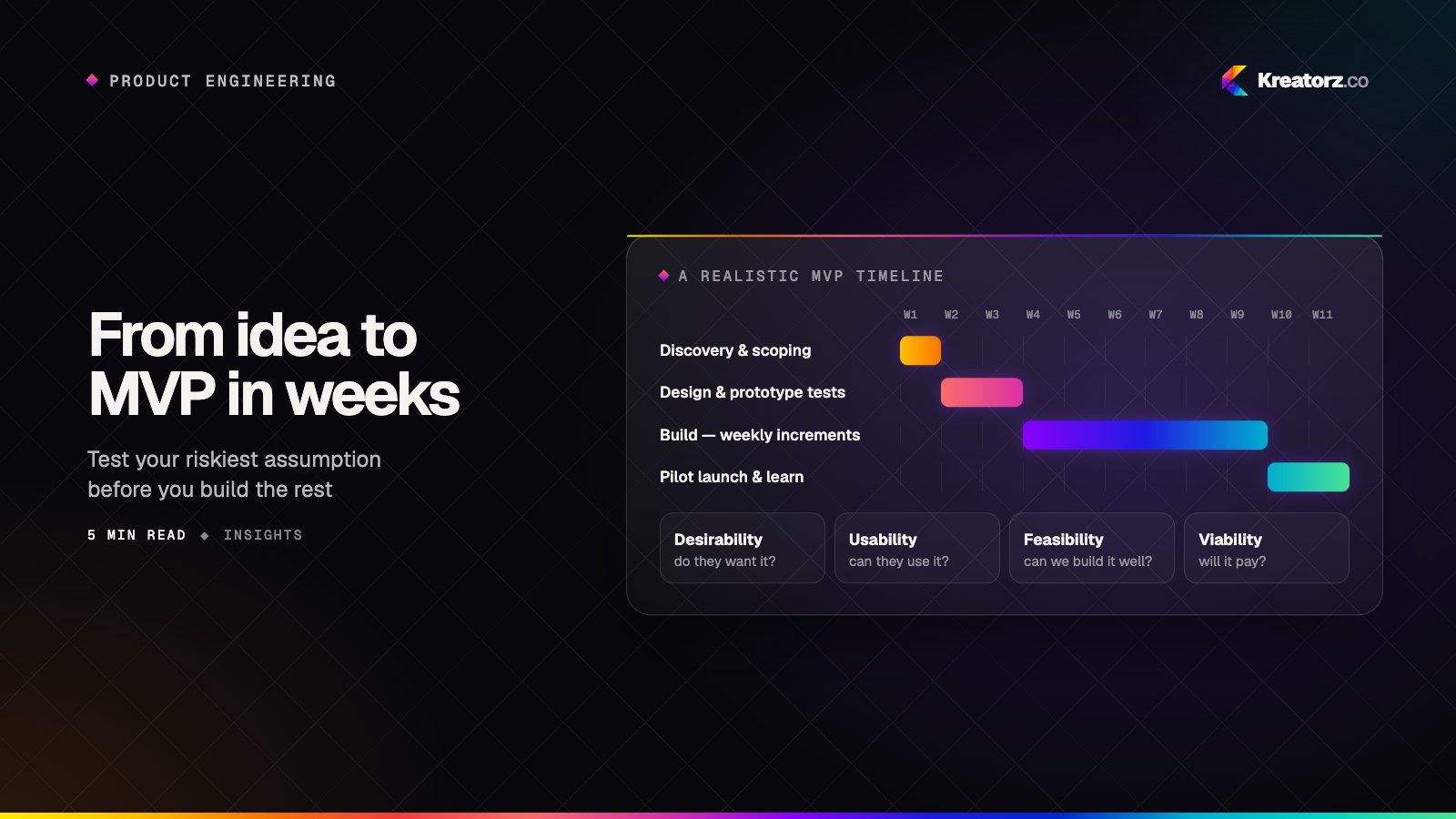
- Development sprints — development builds on your phone every one to two weeks, demoed weekly.
- Testing — Jest unit tests, React Native Testing Library and end-to-end tests on real devices.
- Release — EAS builds, App Store and Google Play submission, and an OTA update channel.
- Evolve — performance profiling, dependency upgrades and new features driven by analytics.
Taking over and upgrading React Native apps
Older React Native apps often fall behind on versions, accumulate unmaintained libraries and struggle with performance. We start with an audit covering dependencies, architecture, crash data and build pipelines, then upgrade in controlled steps — replacing abandoned packages, introducing TypeScript where it is missing and moving to the new architecture when the app is ready.
Why Kreatorz for React Native development
- Web and mobile under one roof. Our React, Next.js and React Native engineers work together, which is what makes code sharing succeed.
- Framework-neutral advice. We build with Flutter and native too, so we only recommend React Native when it is the best fit.
- AI-native product engineering. Recognised with the Global AI Impact Award (Global Image Awards Middle East, Riyadh 2026).
- Clear progress. Weekly demos and a shared backlog, with no surprises at the end.
- Your code and accounts. Repositories, Expo and store accounts are yours from day one.
- Worldwide team. Offices in the United States, Canada and Pakistan. Tell us about your app.