A SaaS product is more than a web app with a login. It needs to onboard customers without a sales call, keep each customer's data separate, charge them correctly, survive growth and give you the numbers to run a business. Kreatorz is a SaaS development company that builds all of it: the product your customers see and the machinery behind it that lets you sell, support and scale.
We work with founders launching a first product, established companies turning an internal tool or service into a subscription offering, and teams whose existing platform has outgrown its original architecture.
What makes SaaS different to build
Most of the effort in a SaaS platform sits in areas a typical website never touches:
- Tenancy. Every query, file and background job must know which customer it belongs to, and must never leak across.
- Self-service. Sign-up, onboarding, invitations, plan changes and cancellation have to work without your team's involvement.
- Billing. Plans, trials, seats, usage, proration, invoices, tax and failed-payment handling.
- Roles and permissions. Owners, admins and members, often with custom roles for larger customers.
- Integrations. Customers expect your product to connect to the tools they already use, through APIs, webhooks and single sign-on.
- Operations. Monitoring, backups, support tooling, feature flags, audit logs and a release process that doesn't interrupt anyone.
Getting these foundations right early is far cheaper than retrofitting them once you have paying customers.
Our SaaS application development services
SaaS MVP
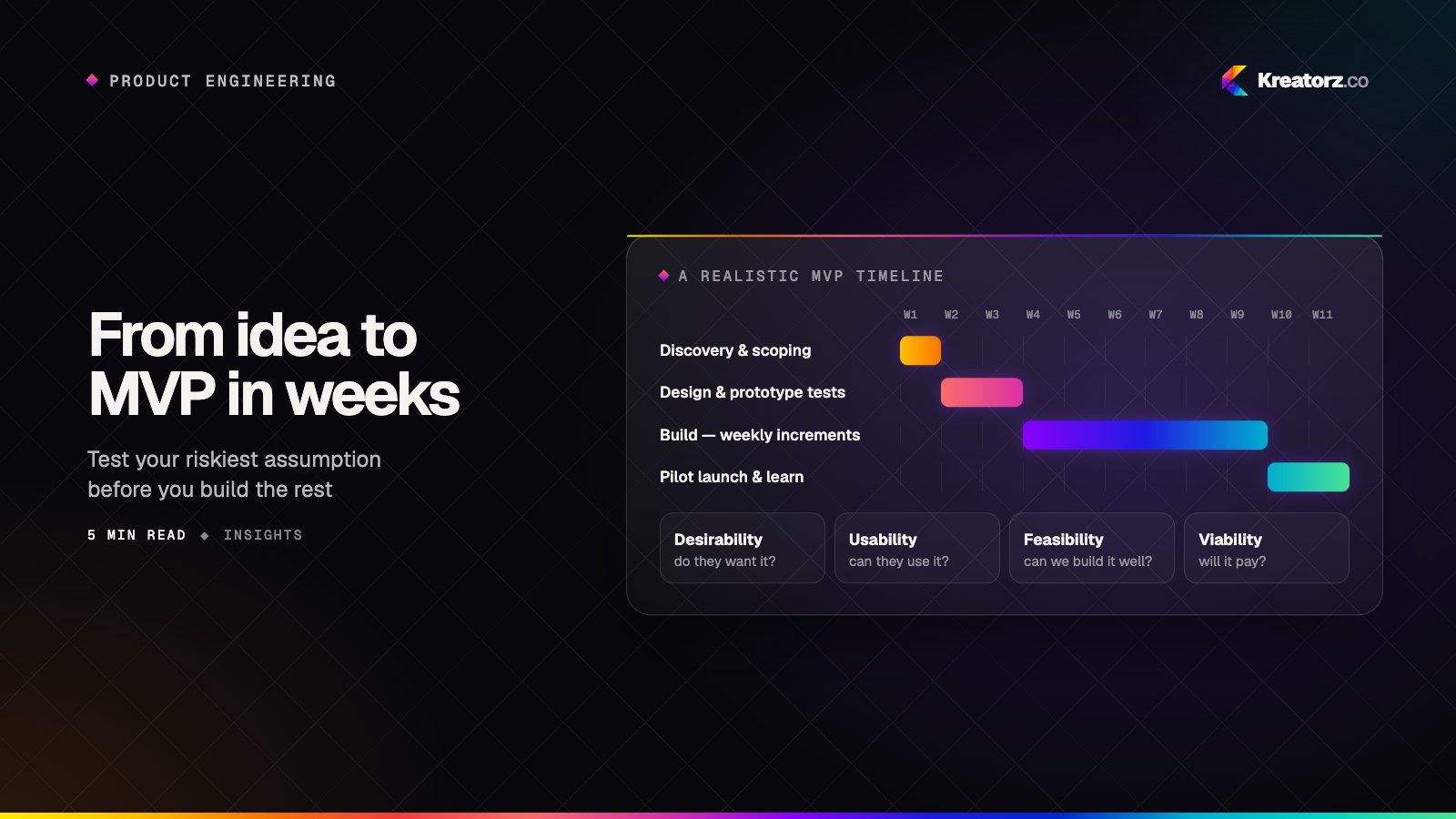
A focused first release that solves one painful problem for a defined customer, with production-grade foundations — authentication, tenancy and billing — so you aren't forced into a rewrite when it works. Our MVP development approach and the article idea to MVP in weeks explain how we keep scope tight.
Custom SaaS development
Full product builds for B2B and B2C markets: customer-facing web app, admin back office, APIs, mobile companion apps where they add value, and the cloud infrastructure underneath. Front ends are typically built in React and Next.js with TypeScript; backends in Node.js, Python or Laravel.
Turning a service or internal tool into SaaS
Many good SaaS ideas start as software a company built for itself. We separate the customer-specific parts, add tenancy, onboarding and billing, and harden security so the product can be sold to others.
Re-architecting and scaling existing SaaS
Slow pages, noisy-neighbour problems, a single database straining under load, releases that need downtime. We review the architecture, fix the bottlenecks that matter most and migrate in stages without stopping feature work. See modernising legacy software.
AI features for SaaS
Assistants, smart search over customer data, automated workflows and predictions, scoped to each tenant's data and permissions. More on our AI app development page.
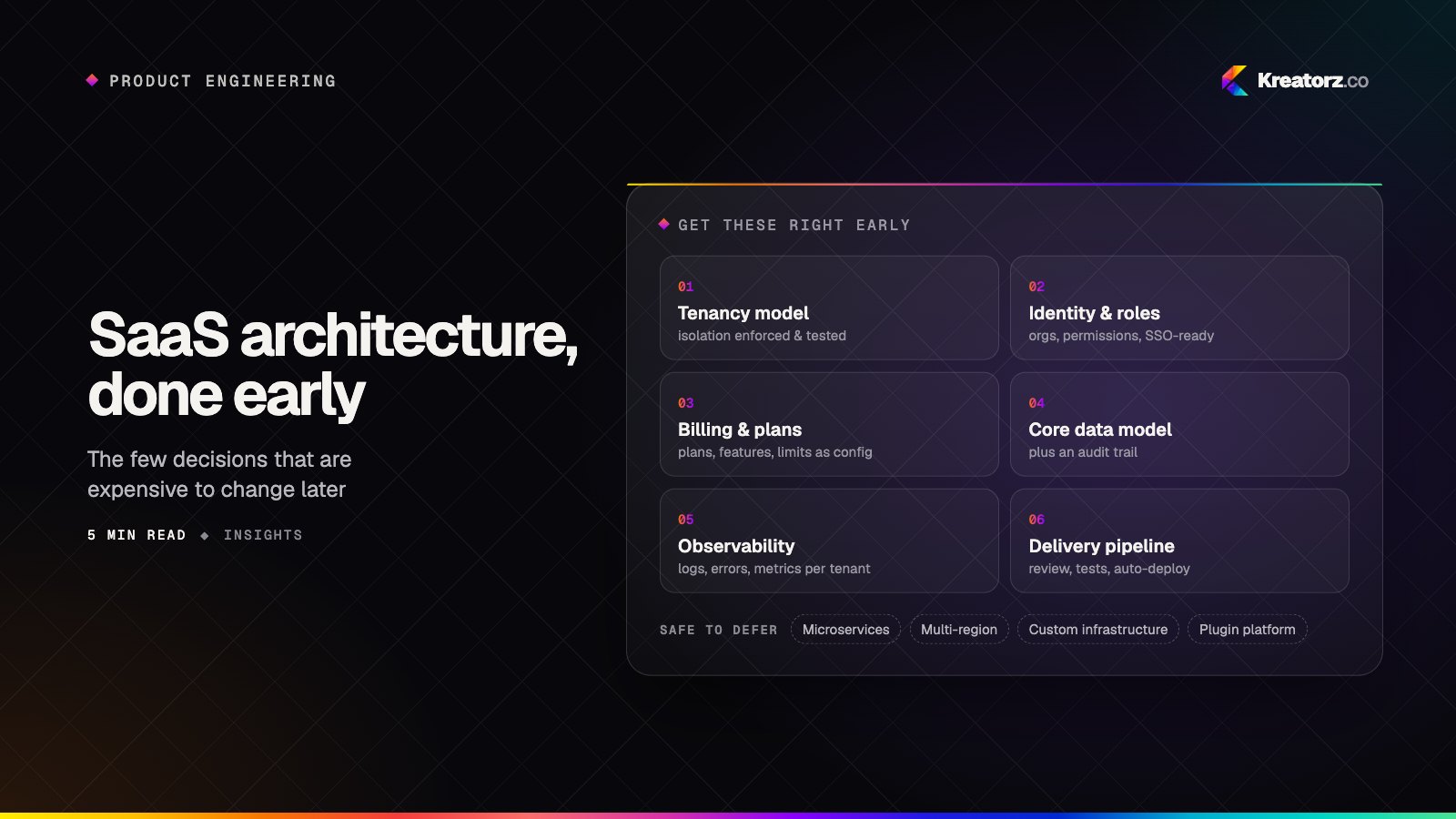
Multi-tenant SaaS architecture options
There is no single right tenancy model; the choice depends on your customers, compliance needs and expected scale. Our article on SaaS architecture decisions goes into the details.
| Model | How it works | Suits | Trade-offs |
|---|---|---|---|
| Shared database, tenant ID on every row | All customers in one schema | Many small and mid-sized customers | Simplest to run; isolation enforced in code and policies |
| Schema per tenant | One database, separate schema each | Moderate number of customers wanting stronger separation | More migrations to manage |
| Database per tenant | Each customer has its own database | Enterprise or regulated customers | Strongest isolation; higher operating effort |
| Hybrid | Shared by default, dedicated for chosen tenants | Products moving upmarket | Two paths to support and test |
We often start shared and design so that large customers can later be moved to dedicated infrastructure without rewriting the application.
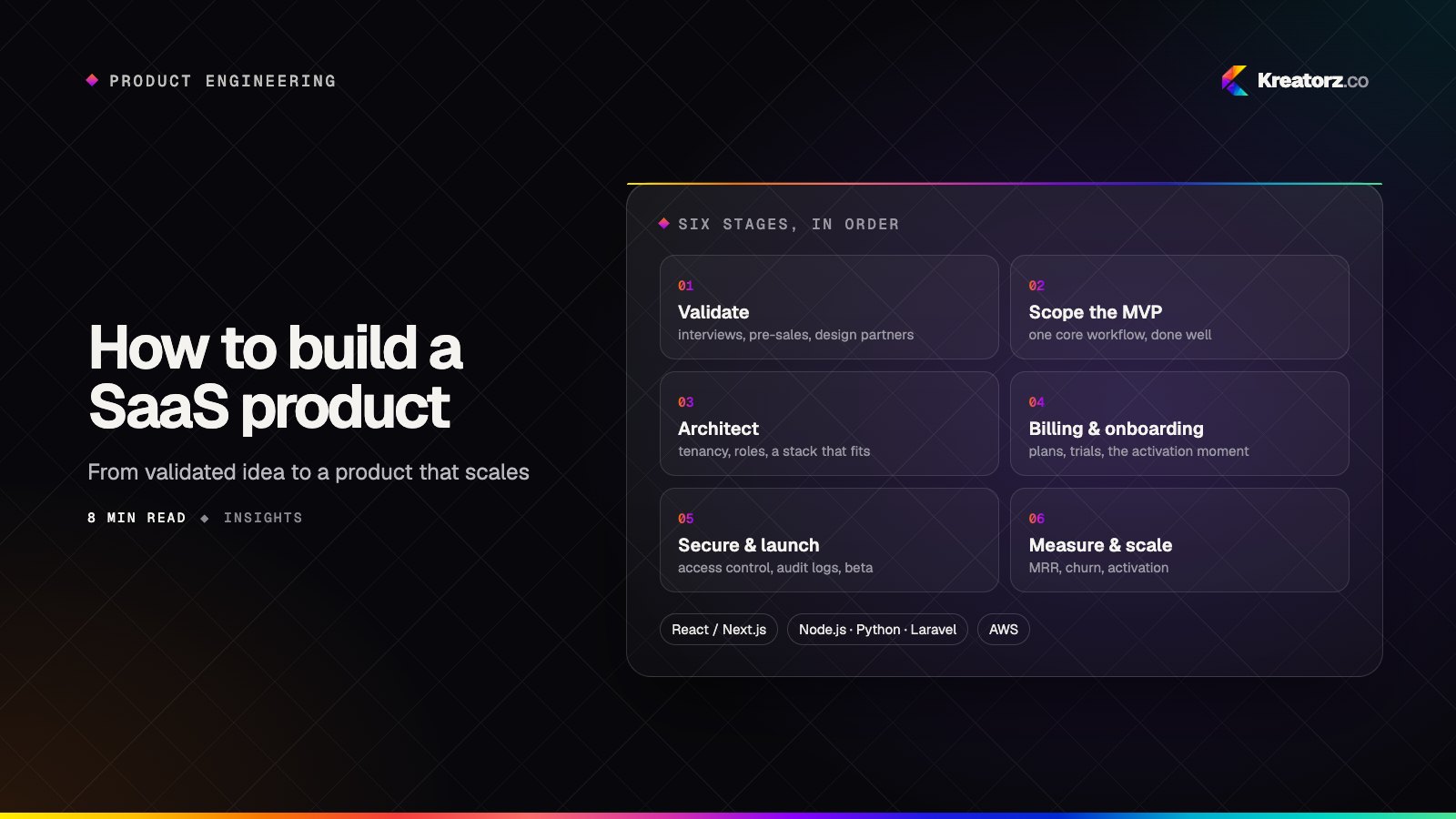
How we build a SaaS product
- Discovery and positioning — who buys, who uses, what they pay for and what the first release must prove.
- Product design — onboarding journey, core workflows, admin experience and pricing-page logic, tested with prospective users.
- Architecture — tenancy model, identity and roles, billing approach, data model, integrations and hosting, written down and agreed.
- Foundations sprint — authentication, tenant setup, billing integration, CI/CD, environments, monitoring and error tracking.
- Feature delivery — short cycles with weekly demos, a shared backlog and a staging environment you can explore.
- Beta and launch — onboarding first customers, gathering feedback, load testing and security review before general availability.
- Run and grow — analytics on activation and retention, performance tuning and a steady release cadence.
What we build
- Service operations platforms that connect customers and businesses — scheduling, records, status updates and communication. Integrity 1st Automotive brings together appointment management, maintenance history, vehicle condition updates and customer records for car owners and repair shops.
- Catalogue and booking platforms combining products with appointments and reminders, like Rose Optometry, which pairs an eyewear catalogue with eye-exam booking and follow-up reminders.
- Vertical SaaS for specific industries, where deep workflow knowledge beats generic tools. Rentech is a digital property rental platform in Saudi Arabia with property search, viewing requests, online rental applications, a broker management portal and Ejar integration with digital contracts.
- B2B workflow and collaboration tools with teams, roles, approvals and audit trails — like Ryvato, a strategic project management platform with OKR and KPI tracking, Gantt scheduling, budget and earned value analytics, and project health scores with risk alerts.
- Client portals that give customers self-service access to documents, requests and status.
- Analytics and reporting products that turn operational data into dashboards customers pay for.
Security, reliability and compliance
Customers trust a SaaS vendor with their data, and larger buyers will ask detailed questions before signing. We build in tenant isolation tests, encryption in transit and at rest, least-privilege cloud access, audit logging, backups with tested restores, dependency scanning and secure development practices. We also prepare the documentation that security questionnaires ask for, and design so that formal certifications can be pursued when your market requires them. Infrastructure is typically built on AWS with everything defined as code.
Why Kreatorz for SaaS development
- Business-aware engineering. We think about pricing, onboarding and retention, not just features.
- End-to-end team. Strategy, UX, full-stack development, DevOps, QA, security and growth marketing in one place.
- AI-native. Recognised with the Global AI Impact Award (Global Image Awards Middle East, Riyadh 2026), we add AI to SaaS products where it makes the product measurably better.
- Transparent delivery. Weekly demos, a shared backlog and honest progress reports.
- Yours from day one. Code, designs, cloud, billing and domain accounts are owned by you.
- Worldwide. Teams in the United States, Canada and Pakistan working across time zones.
Choosing who to build with is a big decision; our guide on choosing a software development partner lists the questions worth asking — including of us. When you're ready, tell us about your product.