SaaS architecture decisions to get right early
Most early SaaS code will be rewritten — and that's fine. But a handful of decisions are expensive to change later. Here are the ones worth getting right in the first months, and the ones you can safely defer.
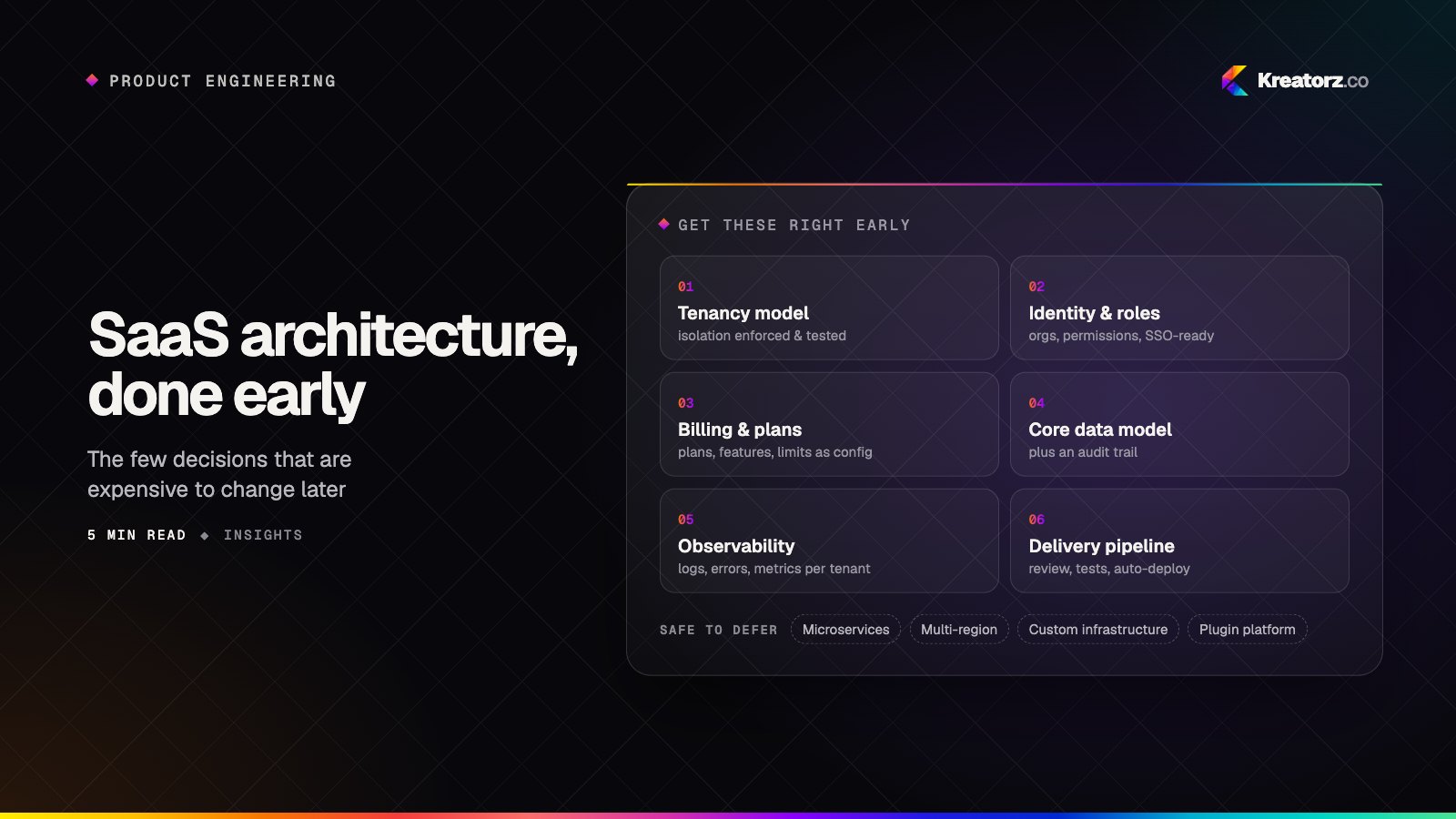
Early-stage SaaS teams are rightly told not to over-engineer. Ship, learn, iterate. Most of the code written in year one will be changed or replaced, and that is how it should be.
But not every decision is equally easy to change. A small number of choices touch every customer, every record and every feature. Get them wrong and you face migrations that freeze product work for months. Get them roughly right and you can move fast for years.
This guide covers the decisions worth thinking about early — and, just as importantly, the ones you can safely leave for later.
The decisions that are expensive to change
1. The tenancy model
Every SaaS product serves many customers ("tenants"). How you separate their data is one of the earliest and most consequential decisions.
| Model | How it works | Best for |
|---|---|---|
| Shared database, tenant column | All tenants in the same tables, every row tagged with a tenant ID | Most B2B SaaS — simple, efficient, scales well |
| Schema per tenant | Same database, separate schema per tenant | Moderate isolation needs, fewer, larger tenants |
| Database per tenant | Each tenant gets its own database | Strict isolation, data residency or very large customers |
For most products, a shared database with a tenant identifier on every record is the right start — as long as tenant isolation is enforced systematically, not by remembering to add a filter to every query. Use row-level security, a data-access layer that always applies the tenant scope, and automated tests that try to read across tenants.
2. Identity, organisations and roles
Retrofitting proper account structures is painful. From the start, model:
- Users who can belong to one or more organisations;
- Roles and permissions within each organisation, checked on the server for every action;
- Invitations and ownership transfer;
- Single sign-on (SAML or OIDC) as a future requirement — larger customers will ask for it.
Use a proven authentication provider rather than building your own, and keep authorisation logic in one well-tested place.
3. Billing and plans
Pricing will change many times. Your architecture should make that cheap:
- Keep a clear separation between plans, features and limits, so changing what a plan includes is configuration, not code.
- Use a billing provider for payments, invoices and tax, and keep your product's record of entitlements in sync through webhooks.
- Design for trials, upgrades, downgrades and seats from the start; they appear sooner than you expect.
4. The core data model
You don't need to model everything up front, but the central entities — what a "project", "account" or "order" means in your product — spread through every feature. Spend real time with domain experts getting the core concepts and relationships right, and prefer additive changes over reshaping core tables later.
Add an audit trail for important actions early. Enterprise customers will ask who changed what and when, and reconstructing it later is rarely possible.
5. Observability
When something breaks for a customer, you need to see what happened. From day one:
- Structured logs that include the tenant and request context;
- Error tracking with alerts;
- Basic metrics for latency, error rates and background jobs;
- Product analytics that tell you which features are actually used.
These are cheap to add early and very expensive to wish you had during an incident.
6. The delivery pipeline
Automated builds, tests and deployments are not a luxury for later. A reliable pipeline — every change reviewed, tested and deployable — is what lets a small team ship safely many times a week. Add separate environments for development, staging and production, and manage infrastructure as code where you can.
Decisions you can safely defer
Just as important is what not to build yet:
- Microservices. A well-structured modular monolith is faster to build, easier to operate and simpler to change. Split services out when a clear scaling or team boundary demands it.
- Multi-region deployment. Start in one region close to your customers; plan for data residency only when a real customer requires it.
- Custom infrastructure. Managed databases, queues and hosting free your team to work on the product.
- Premature performance optimisation. Measure first. Most early performance problems are a missing index or an inefficient query, not an architectural flaw.
- A plugin or extension platform. Build integrations directly for the first few; generalise once you see the pattern.
Building in quality without slowing down
A few habits keep a fast-moving codebase healthy:
- Modular boundaries inside the monolith — billing, accounts, core domain — with clear interfaces between them.
- Feature flags to release gradually, test with selected customers and roll back without redeploying.
- Background jobs for slow work (emails, imports, reports, AI processing), so the product stays responsive.
- Tests focused on what matters most: tenant isolation, permissions, billing logic and core workflows.
Planning for AI features
Many SaaS products now add AI capabilities. A few architectural choices make that easier:
- Keep your data well structured and permission-aware, so AI features can retrieve only what each user is allowed to see.
- Run AI work asynchronously where possible, with progress shown to the user.
- Track usage per tenant, both for cost control and for pricing AI features fairly.
- Keep model providers behind your own interface so you can change models as they improve.
A checklist for your first architecture review
- Is tenant isolation enforced automatically and tested?
- Can a user belong to several organisations with different roles?
- Can we change what a plan includes without a code change?
- Do we keep an audit trail of important actions?
- Can we see errors, slow requests and failed jobs per tenant?
- Does every change go through review, tests and an automated deployment?
- Are we deliberately not building microservices, multi-region or custom infrastructure yet?
The bottom line
Good early SaaS architecture is not about predicting the future; it is about keeping it cheap to change. Get tenancy, identity, billing, the core data model, observability and delivery right — and defer everything else until the product and its customers tell you it's needed.
Building or scaling a SaaS platform? Talk to our team — we help founders make these decisions with the next three years in mind, not just the next three sprints.
Related services
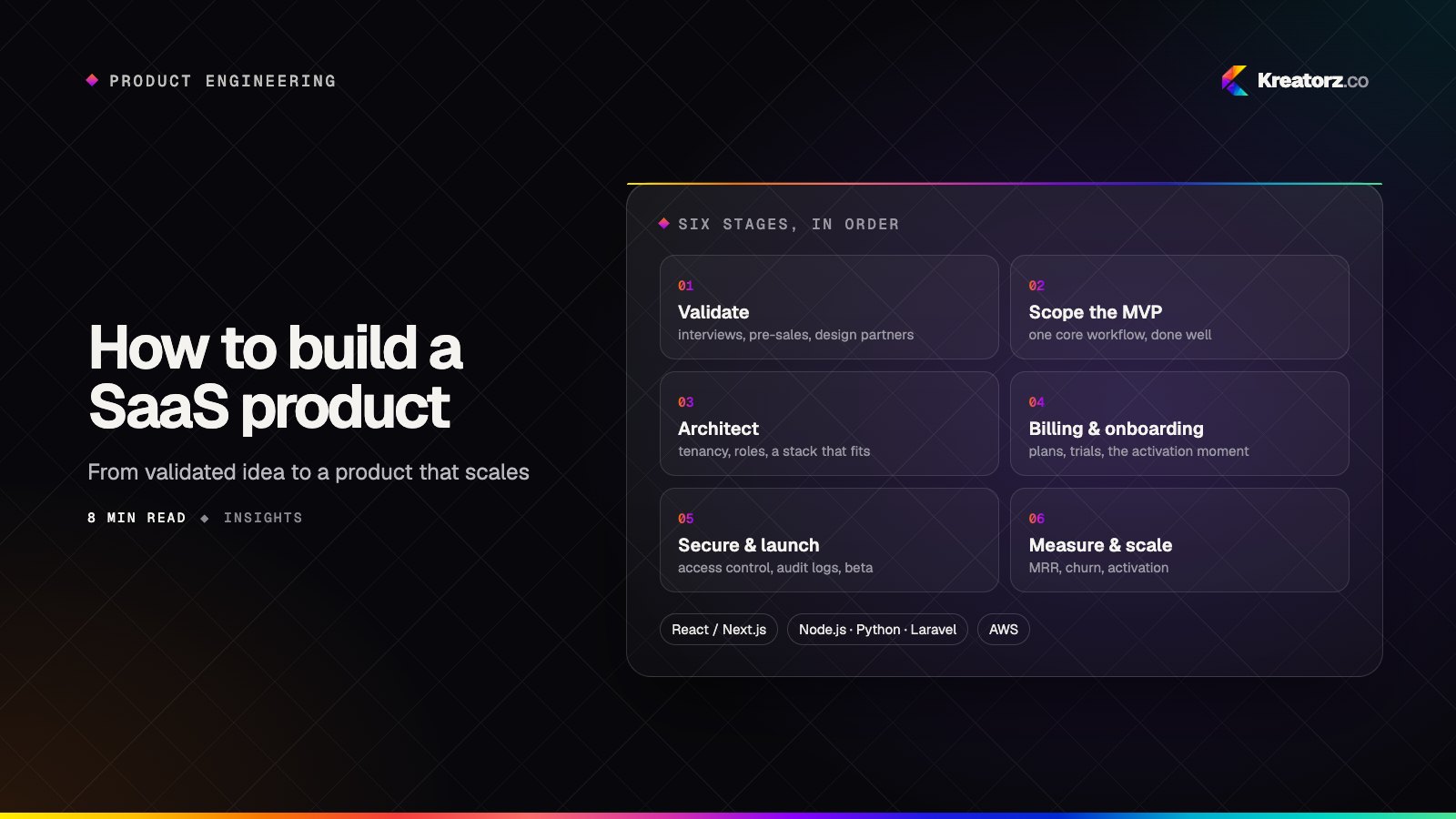
How to build a SaaS product: a step-by-step guide from idea to scale
Building a SaaS product means building two things at once — the product customers use and the machinery that lets you sell, bill, support and scale it. Here is the process, step by step, from validating the idea to growing beyond your first customers.
15 November 2026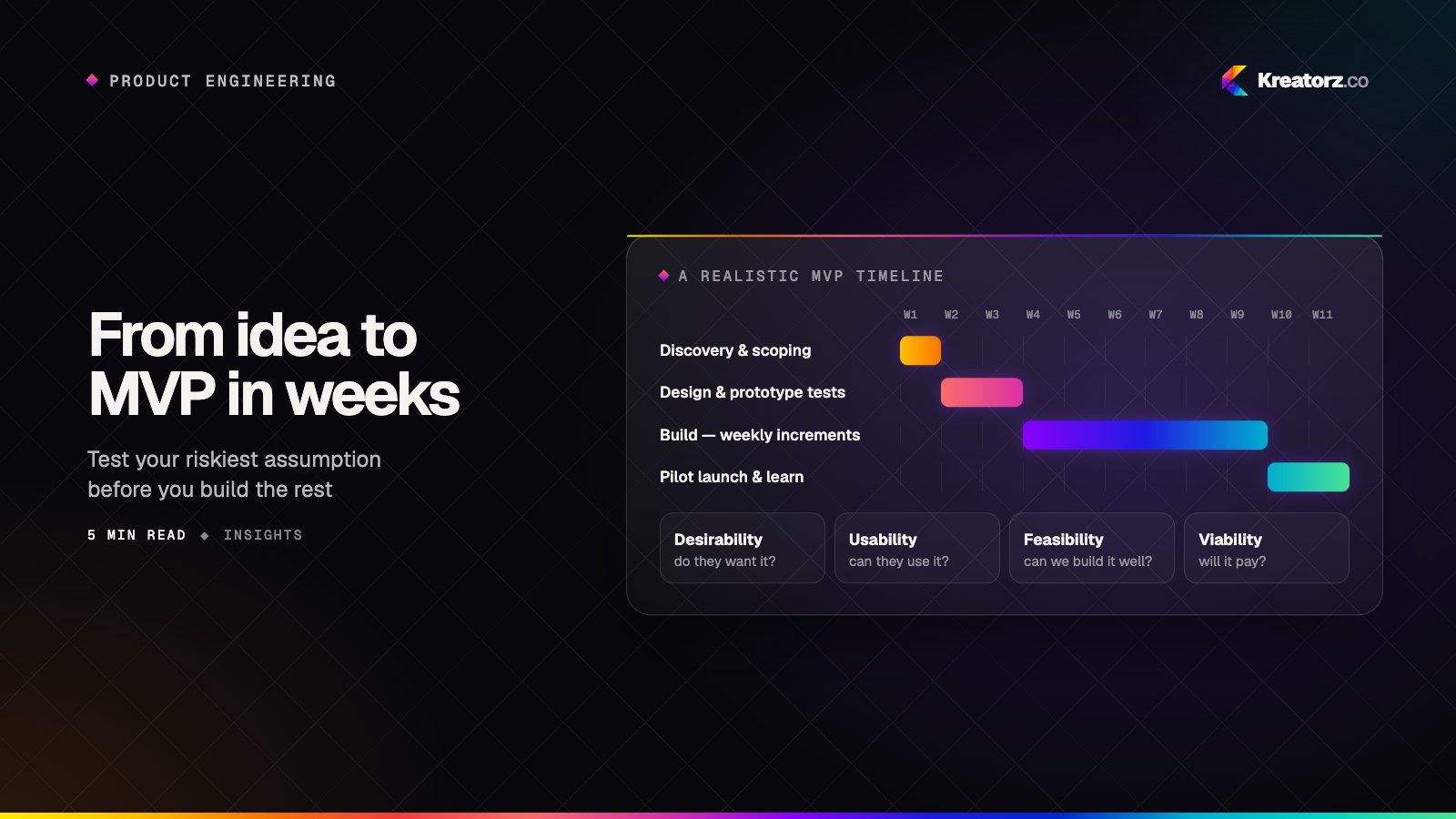
From idea to MVP in weeks: how to de-risk a new product
A minimum viable product is not a smaller version of the final product — it is the fastest honest test of your riskiest assumption. Here is the process we use to launch quickly without building the wrong thing.
14 October 2026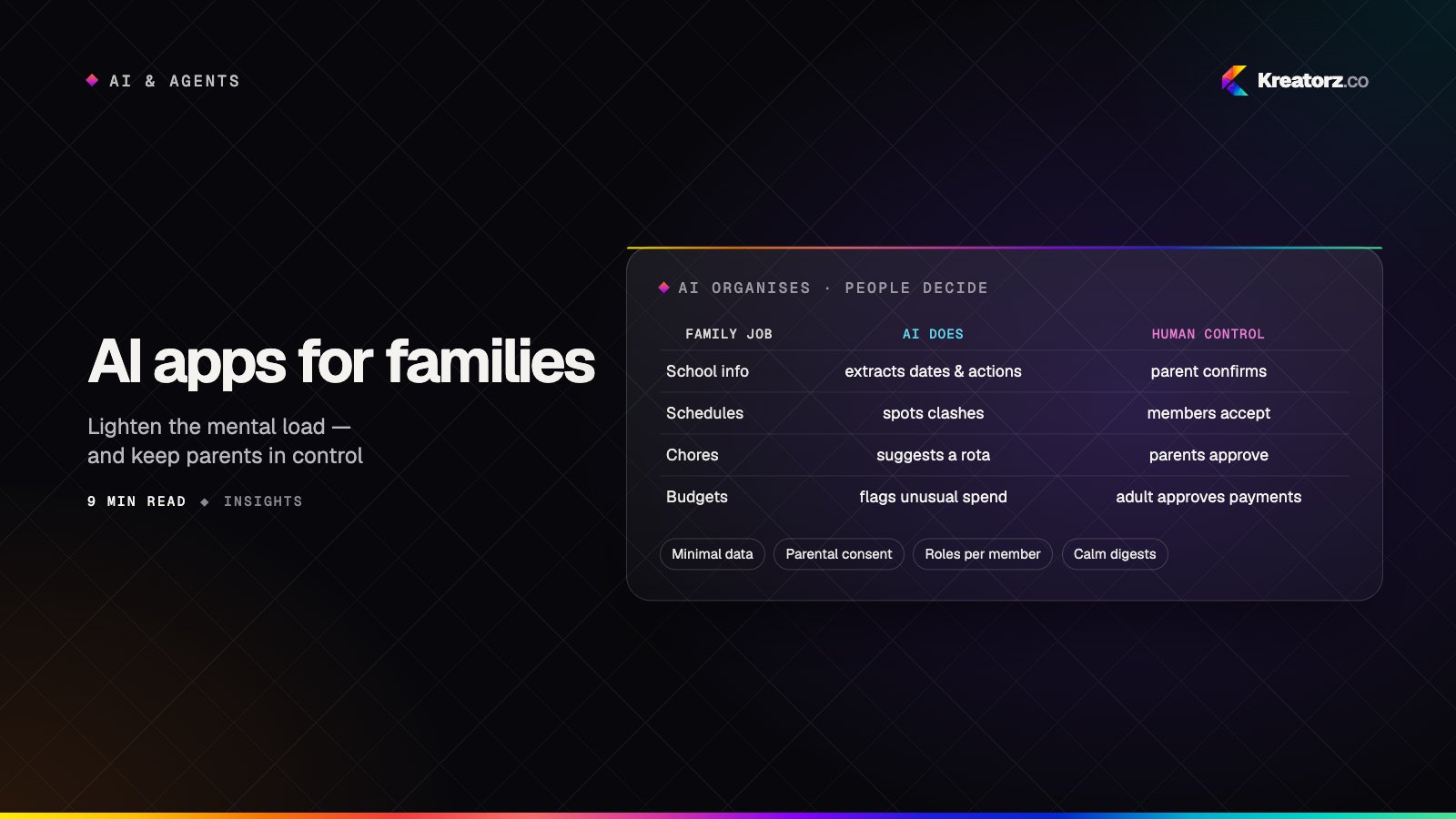
AI apps for families: how to build a family app parents actually trust
Families are drowning in schedules, school emails and small decisions. AI can genuinely lighten that load — if it is designed around real household jobs, several family roles, children's privacy and clear human control. A guide for product teams.
15 November 2026