Python is the rare language that is equally at home serving a web API, moving millions of rows between systems and running a machine learning model. That breadth is why so many products end up with Python somewhere in their stack — and why the quality of that code matters. Kreatorz is a Python development company that builds the production side of Python: typed, tested, observable services that your team can run and extend, not notebooks that only work on one laptop.
We use Python where its ecosystem gives you a real advantage: AI and data-heavy products, automation, scientific or numerical work, and web backends that need to sit close to all of the above.
Where Python gives your product an edge
- AI and machine learning. Almost every serious model library, evaluation tool and vector database client is Python-first. Building your backend in the same language removes a translation layer.
- Data engineering. Extracting, cleaning, transforming and loading data from many sources, on a schedule or in response to events.
- Rapid, readable development. Python's clarity makes business rules easy to review — useful when domain experts need to check the logic.
- Automation. Scripts and services that replace manual reporting, reconciliation, document handling and back-office tasks.
- Mature web frameworks. Django and FastAPI are both proven choices for serious production systems.
If your product is mostly real-time messaging or a TypeScript-heavy web app, Node.js may suit better, and we will say so. Many of our architectures combine the two.
Python development services
Django development
Content-rich platforms, multi-role portals and business applications that benefit from Django's built-in admin, ORM, authentication and security defaults. Django lets a small team deliver a lot of reliable functionality quickly, and its admin is often the fastest route to a usable back office.
FastAPI development
High-performance, asynchronous APIs with automatic OpenAPI documentation and request validation through Pydantic. FastAPI is our usual choice for API-only services, AI model endpoints and microservices that sit behind a React front end or a mobile app.
Data pipelines and integrations
Batch and streaming pipelines that pull from databases, files, SaaS tools and APIs, then validate and load the results into a warehouse or operational database. Orchestration with tools such as Airflow or managed cloud schedulers, with retries, alerting and data-quality checks built in.
AI and LLM integration
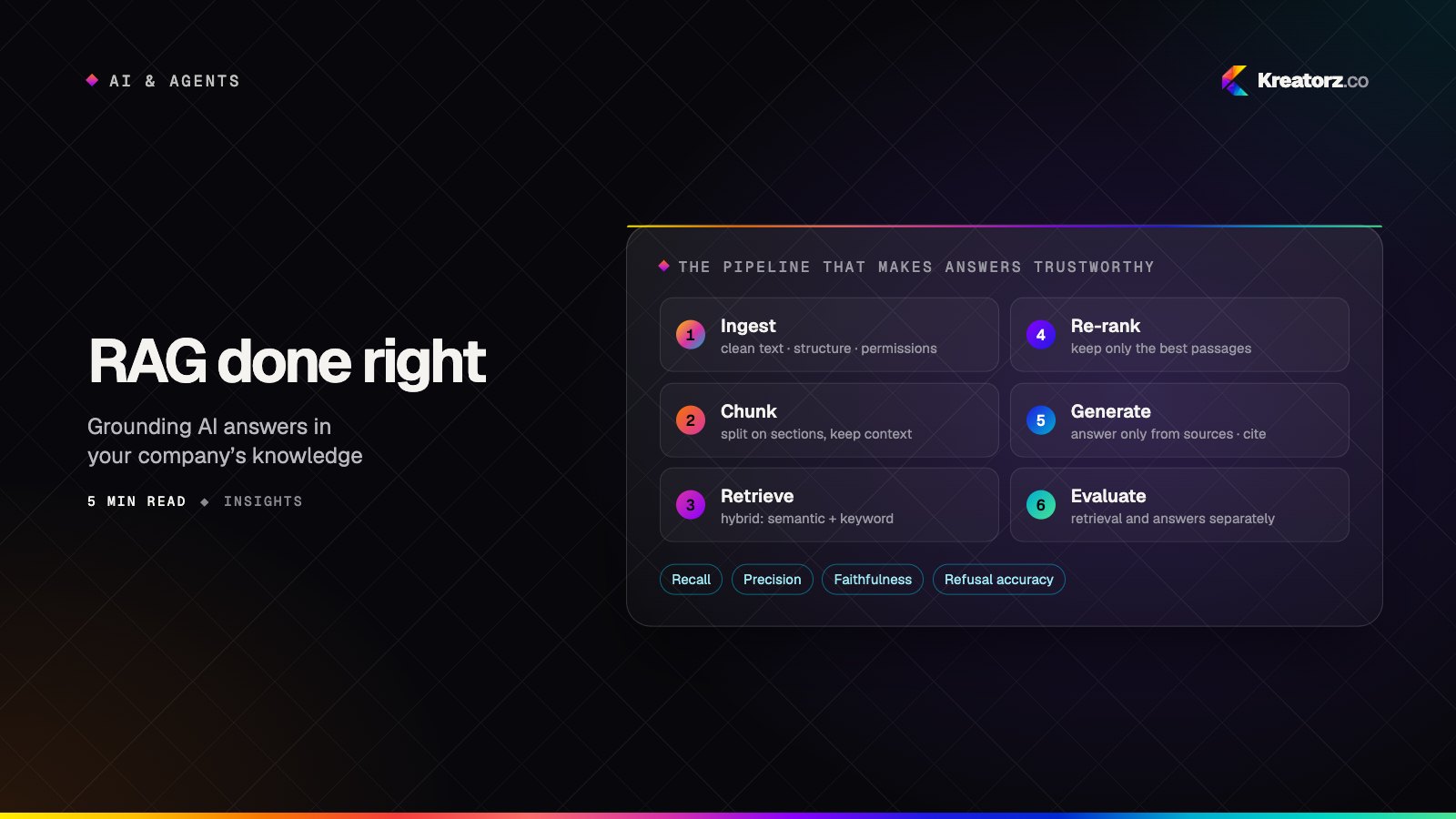
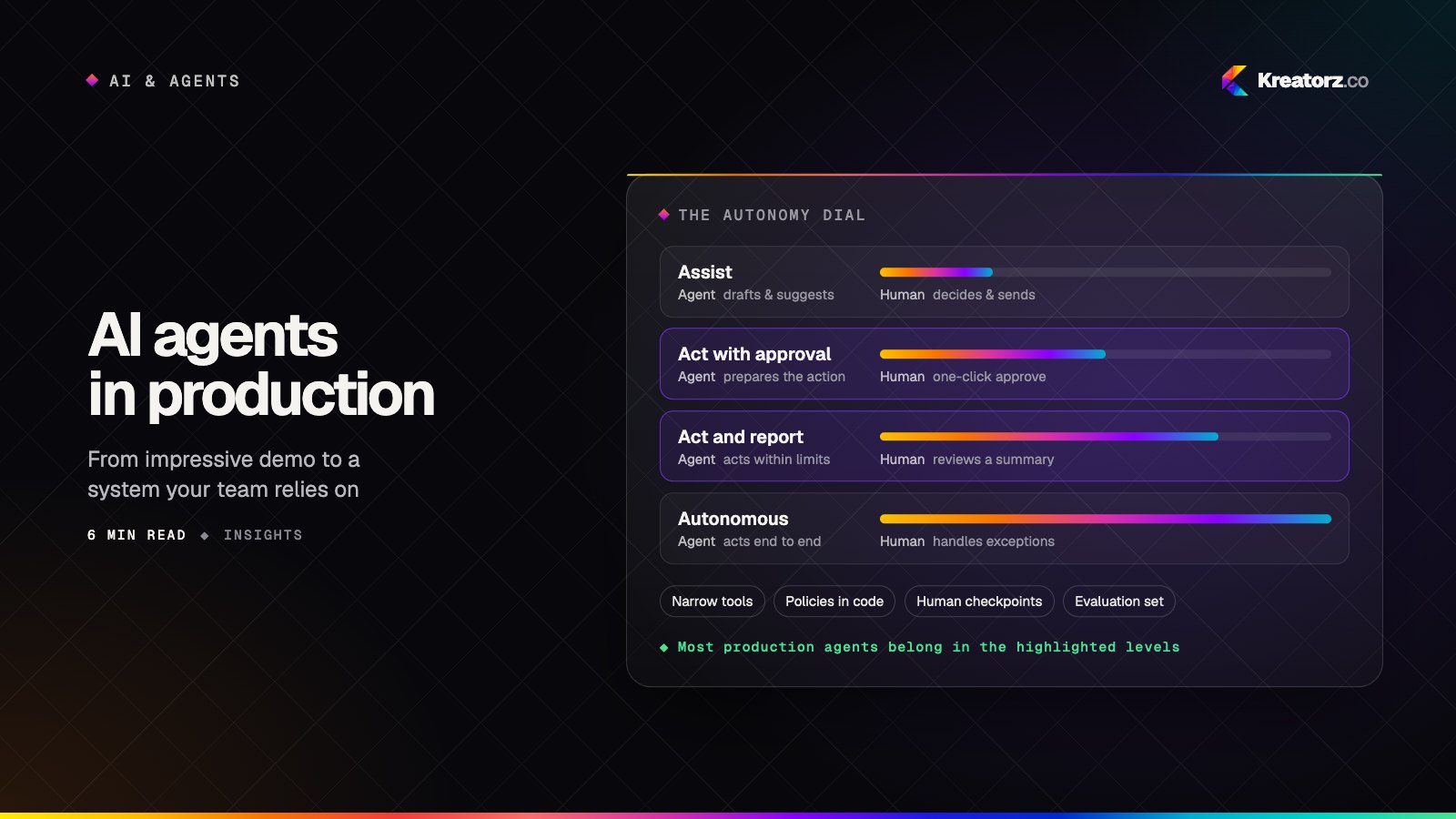
Retrieval-augmented generation over your documents, structured extraction, classification, summarisation and agent workflows, connected to your existing systems with proper permissions. Our article on RAG done right explains the design choices, and our AI agent development and machine learning development pages go further.
Automation and scripting
Scheduled jobs, document processing, report generation and system-to-system syncs that remove repetitive work. We package them as maintainable services with logging and configuration, not one-off scripts.
Django vs FastAPI vs Flask
| Django | FastAPI | Flask | |
|---|---|---|---|
| Philosophy | Batteries included | API-first, type-driven | Minimal core, add what you need |
| Built-in admin | Yes | No | No |
| Async support | Partial, improving | Native | Limited |
| Validation and docs | Forms and serializers (via Django REST Framework) | Pydantic models, automatic OpenAPI | Via extensions |
| Best for | Full web applications and portals | APIs, AI services, microservices | Small services and prototypes |
There is no wrong answer among the three — only a poor fit. A product that needs a rich admin and server-rendered pages leans towards Django; a set of APIs serving AI models leans towards FastAPI.
From prototype to production — our process
- Clarify the job. Whether it is an API, a pipeline or an AI feature, we define inputs, outputs, success measures and failure modes.
- Inspect the data. Real samples, edge cases and quality problems are surfaced before architecture decisions are locked in.
- Design the service. Framework choice, data model, queues, storage and deployment target, agreed with you in writing.
- Build with types and tests. Type hints checked in CI, Pydantic models at every boundary, and unit and integration tests for core logic.
- Evaluate AI components. For model-backed features, we build evaluation sets and measure quality before and after every change.
- Package and deploy. Containers, dependency pinning, infrastructure as code and CI/CD to your cloud — often AWS.
- Monitor and improve. Logs, metrics, data-quality alerts and, for AI features, tracking of cost, latency and output quality over time.
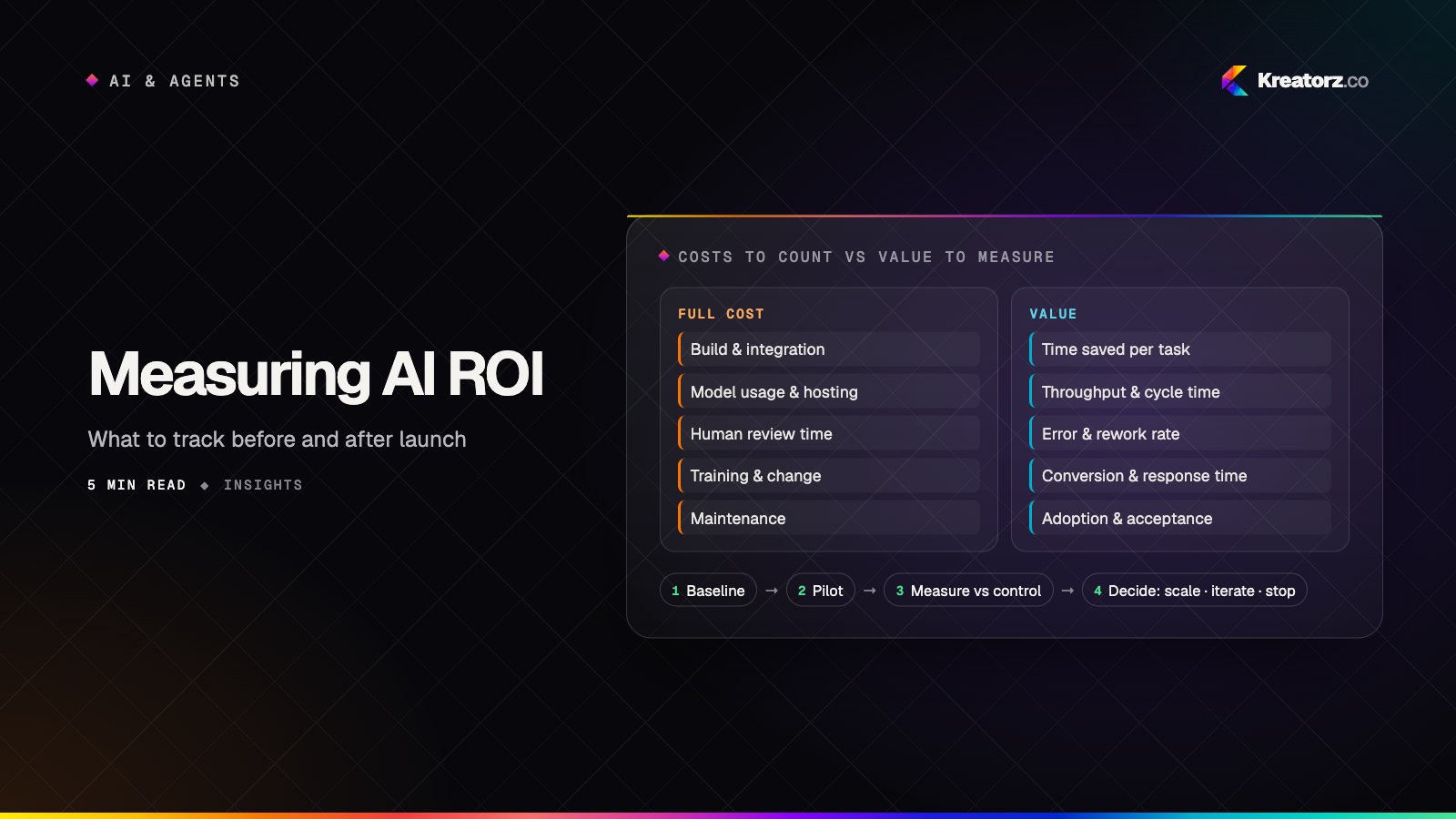
Before investing heavily in an AI feature, it helps to decide how you will judge it. Our guide to measuring the ROI of AI projects is a good starting point.
What we build with Python
- AI-powered product features such as assistants, image analysis and personalised recommendations. Checkpoint AI scans purchases with AI and checks them against a smart blocklist, and Luna pairs an AI vet chat with symptom and image analysis — good examples of the kind of products where this logic adds value.
- Web backends and portals with Django for organisations that need multiple roles and a strong admin.
- API platforms with FastAPI serving web and mobile clients.
- Internal automation that replaces spreadsheets and manual exports.
- Data platforms consolidating information from scattered systems into one reliable source.
- AI products where the backend and the model logic live together; see AI app development.
Why Kreatorz for Python development
- Production discipline. Typed code, automated tests, CI/CD and monitoring are standard, whatever the size of the job.
- AI-native team. We received the Global AI Impact Award at the Global Image Awards Middle East in Riyadh, 2026, and treat AI engineering as core work, not an add-on.
- Whole-product view. Python services are built alongside the front end, mobile app and cloud by one team — see full stack development.
- Honest stack advice. We will recommend another language where it fits your product better.
- Clear ownership. Your code, data, models and cloud accounts are yours from the first day, with weekly demos and a shared backlog.
- Worldwide. Offices in the United States, Canada and Pakistan.
Have a Python project or an AI idea to test? Get in touch.